
Vehicle category · Trailer Verlichting
Semi-trailer lighting — markers, rears, end-outline.
A semi-trailer takes more lamps than the tractor pulling it: side markers every 3 metres, end-outline markers at the corners, twin rear combinations, licence-plate lamps, and on tank or curtain-side variants additional under-running protective lamps. This page covers the spec, the failure modes, and what to fit on which trailer type.
Laatst bijgewerkt 24 april 2026

Mandatory lamps on a trailer
Every semi-trailer over 6 metres wide or long must carry, at minimum:
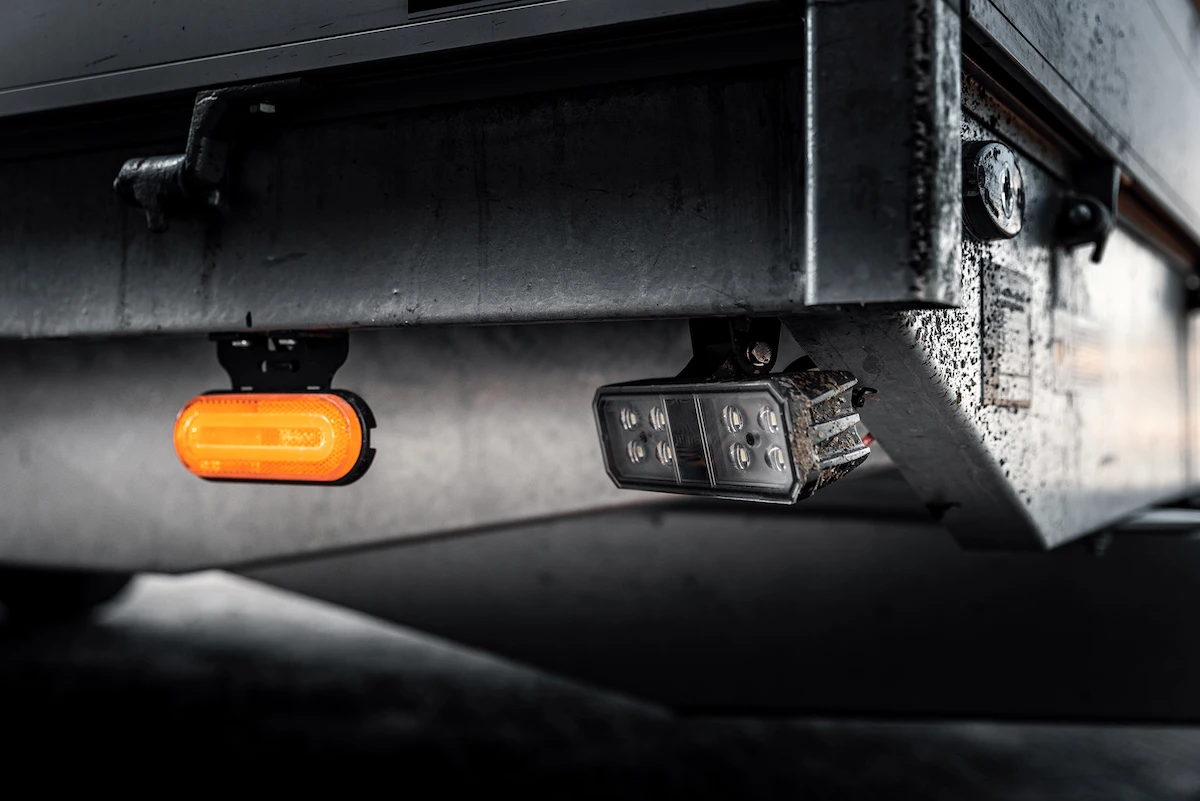
- **Two red rear position lamps** (R7), one each side - **Two red stop lamps** (R7), one each side - **Two amber rear direction indicators** (R7 / R148) - **Two red end-outline marker lamps** at the upper corners - **Two white front end-outline marker lamps** if the trailer body is wider than the tractor - **Amber side-marker lamps** at maximum 3-metre spacing along each side, plus one within 3 m of front and rear - **Licence-plate lamp** (R4 / R148) - **Two red rear reflectors** (triangular for trailers, square for tractors)
Optional but commonly fitted: rear fog lamps, reversing lamps, work lamps for loading-bay use.
Trailer types — what to fit
**Tautliner / curtain-side**: marker lamps recess-mounted into the curtain frame, rear combinations on the rear pillar. Standard ISO 12098 7-pin connector to the tractor.
**Box / rigid body**: marker lamps fitted into the side panel either flush or surface-mount; rear combinations integrated into a steel back-plate. Often runs an extra 24V interior loom for cargo lighting.
**Tank / chemical**: ADR-compliant electrical install required; lamps need IP69K plus higher temperature ratings. Hazard beacon mandatory during loading/unloading.
**Glass / specialist**: extra side-marker pattern for visibility around the glass cassettes; usually amber with a higher-flash variant available.
**Lowloader / heavy-haul**: extra forward-facing position lamps; chassis-edge lamps to outline non-standard load profiles.
The connector chain
Every trailer connects to the tractor through a 7-pin, 13-pin or 15-pin (Renault Trucks) connector at the cab back wall. The pin-out is standardised under ISO 11446 / ISO 12098, but the wire colours from the trailer end can vary between manufacturers.
Consequence: don't trust the colour at the cab end if the trailer was built post-factory. Always check pin-by-pin with a continuity tester before fitting LED replacements; one wrong assumption can swap your reverse lamp for the tail circuit and trigger an MOT failure on the next inspection.
An LED tail that flashes for half a second when the brake is off is wired to the wrong pin. We see it on about 5% of post-build retrofit trailers.
Why LED on trailers pays back fast
Trailer lamps lead a hard life: jet-washed, vibrated, salt-soaked. A filament position lamp on a high-utilisation trailer typically lasts 8–14 months. An LED equivalent lasts the operational life of the trailer.
Across a 20-trailer fleet, switching from filament to R148-approved LED rear combinations eliminates ~80 unscheduled lamp replacements per year, plus the roadside callouts they trigger. The payback on a full LED conversion sits around 5–7 months.