
Vehicle category · Heftruck Verlichting
Forklift lighting — work lamps, beacons, blue-spot zones.
Forklifts spend 100% of their working life in environments with poor visibility — warehouse aisles, loading docks, cold-store interiors, manufacturing floors. The lighting decisions on a forklift are pure safety: the goal is to keep pedestrians and other equipment from walking into the truck's path. ECE rules don't apply (forklifts aren't road vehicles), but warehouse safety standards (ISO 3691, EN 1175) and individual operator-policy rules absolutely do.
Laatst bijgewerkt 24 april 2026
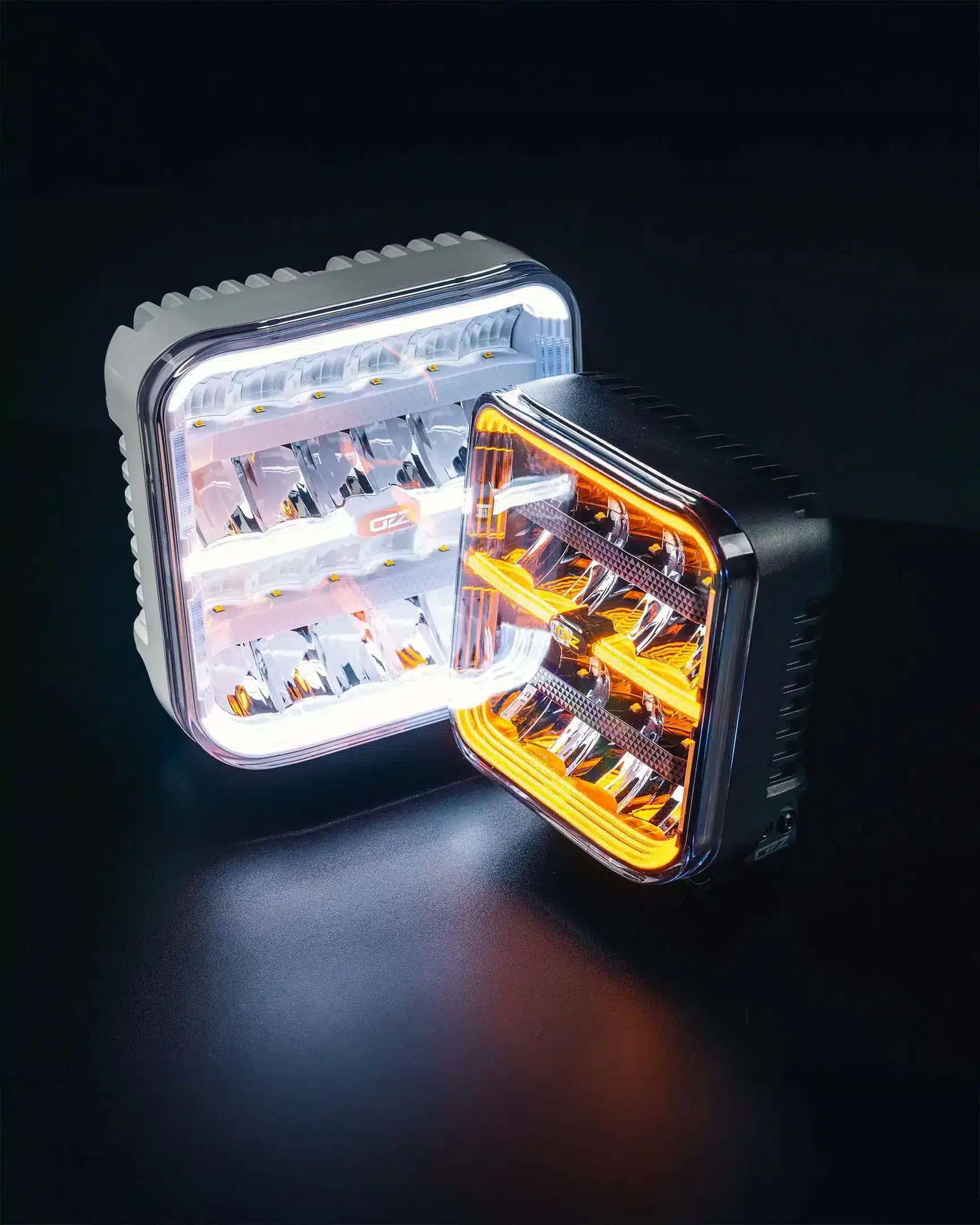
The four lighting roles on a forklift
**Drive-direction work lamps**: dual front and dual rear, illuminating the path of travel. White, around 1500–3000 lumen each. Most modern forklifts have these factory-fitted but the lamps age into dimness.
**Mast / fork lighting**: a small lamp on the carriage, lighting the load and the rack faces. Helpful in dim warehouses; mandatory on some cold-store operations.
**Pedestrian-warning beacons**: amber R65-equivalent flashing beacon on the cab roof, or a "blue-spot" projector that throws a fixed blue circle on the floor 5–8 metres ahead of the forklift. The blue-spot is becoming the de facto safety standard in modern warehouses.
**Red-pedestrian-zone projectors**: red LED line projectors mounted on the sides of the truck, throwing red lines on the floor that mark the truck's swept path during turns. Pedestrians stay outside the line.
The blue-spot — what it does
A blue-spot is a high-intensity LED lamp with a precision-focused beam that projects a blue dot on the floor 5–8 metres ahead of (or behind) the forklift. It costs more than a beacon and provides a different signal: the dot moves with the truck, so a pedestrian walking toward it sees the spot growing closer in their peripheral vision before they hear or see the truck itself.
Most blue-spots are 12V or 24V, IP67-rated, mountable on the overhead guard. Brand-name units run €80–€200; budget Asian imports are available at €30–€50 but with shorter service life and less consistent beam shape.
We stock professional blue-spots in our beacon category. The Asian-import end isn't on our shelf.
Cold-store and freezer applications
Cold-store forklifts (operating below 0°C, often down to −30°C in deep-freeze warehouses) face two extra lighting challenges:
**Cold-start**: lamp drivers need to function at start temperature. Most outdoor-rated LED lamps (operating temperature −20°C and warmer) refuse to start at −25°C or below. Cold-store-spec lamps need −40°C cold-start tested.
**Condensation cycling**: a forklift that goes from −25°C in the freezer to +5°C on the loading dock cycles through dew-point twice per shift. Lamps with imperfect seals fog up internally within weeks. IP69K or IP68 with declared moisture-cycle testing is essential.
We stock cold-store-spec work lamps separately. Ask if the catalogue listing doesn't say "−40°C cold-start" — we'll point at the right SKU.
A €30 LED that fogs up inside three months in a cold store costs more in pedestrian-safety risk than a €120 cold-spec lamp does in upfront price.
Voltage on forklifts
Most modern electric forklifts run 24V, 36V or 48V batteries. LPG and diesel forklifts typically run 12V or 24V. Wide-input lamps (9–33V) cover the 12V/24V range; for 36V or 48V battery forklifts, a step-down DC-DC converter is needed before the lamp.
We supply 36V/48V → 24V converters for this purpose. Around €40 per unit, sized for the load of a single light or a small cluster. Fitting takes ~10 minutes and lasts the operational life of the lamp.